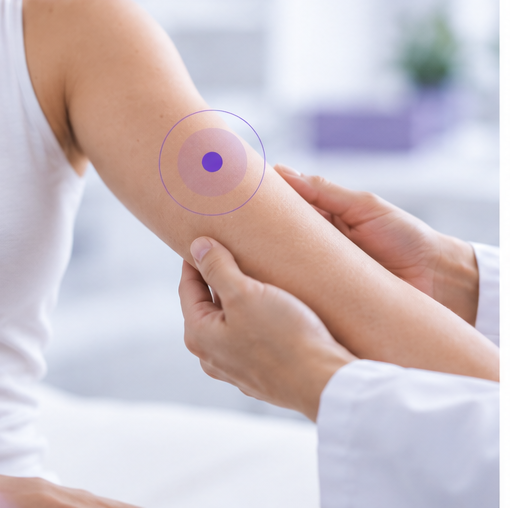
A PWC value tells you how much tissue water is measured at one location. A ratio helps answer another clinically important question: how different is that location from an appropriate reference site?
Localized tissue-water measurement is powerful because it allows clinicians to assess a specific area.
But a single tissue-water value does not always tell the whole story.
Normal tissue-water content varies between anatomical locations and between individuals. This is why, whenever an appropriate reference site is available, comparing two anatomically corresponding locations can provide additional clinical context.
This comparison is expressed as a PWC ratio.
What is a PWC ratio?
LymphScanner displays localized tissue water as Percentage Water Content, or PWC.
When two anatomically corresponding sites are compared, the ratio expresses the relative difference between them.
For example:
Reference arm PWC = 32%
Area of interest PWC = 40%
Ratio = 40 / 32 = 1.25
A ratio of 1.25 means that the measured tissue-water value at the area of interest is 25% higher than at the reference site.
It does not mean that the entire arm contains 25% more fluid.
The comparison applies only to the localized tissue volumes being measured.
Why not rely on the absolute PWC value alone?
Absolute PWC is useful.
It tells clinicians how much tissue water is measured at that particular location and can be followed longitudinally when measurements are performed consistently.
However, absolute tissue-water values vary by:
- anatomical location
- skin and subcutaneous tissue composition
- age
- body composition
- measurement conditions
- individual physiology
For this reason, a value that is high for one anatomical location may be normal for another.
A ratio helps reduce some of this uncertainty by using the patient's own anatomically corresponding tissue as the reference.
PWC tells us what is happening here.
A ratio tells us how different here is from there.
Why are ratios particularly useful in lymphedema?
Lymphedema is often asymmetric.
In unilateral disease, one side can therefore provide useful patient-specific reference information for the other.
This is especially useful because the new anatomical and ICG literature reinforces that the lymphatic system itself is regional and heterogeneous.
Different lymphatic pathways can be affected to different degrees, and early dermal backflow may be localized rather than uniformly distributed throughout the limb.
That means the relevant question is often not:
“Is the whole arm abnormal?”
but rather:
“Is tissue water at this specific site unusually different from the corresponding reference site?”
This is exactly what a localized ratio helps quantify.
Ratios help identify regional asymmetry
Suppose a patient has the following measurements:
Upper arm ratio = 1.30
Forearm ratio = 1.07
These values should not be considered contradictory.
They may indicate that tissue-water asymmetry is more pronounced in one region than another.
This fits the current understanding of lymphedema physiology.
Early dermal backflow can be small and patchy, and nearby lymphatic pathways may remain functional. As disease progresses, the area of dysfunction can become more extensive.
Localized ratios therefore help clinicians investigate regional tissue-water patterns, rather than forcing the entire limb into one normal/abnormal category.
What does a ratio of 1.20 mean?
A ratio of:
1.00 means the two sites have the same measured PWC.
1.10 means the numerator site has 10% higher PWC.
1.20 means it has 20% higher PWC.
But 1.20 is not a biological switch.
Lymphedema does not suddenly begin when the value changes from 1.19 to 1.20.
Thresholds are useful because they help clinicians understand how unusual an observed difference is compared with healthy reference populations.
A large healthy-reference dataset of 403 women showed that only a very small proportion had an inter-arm TDC ratio above 1.20.
The significance of 1.20 is therefore statistical:
An inter-arm ratio above 1.20 represents a degree of local tissue-water asymmetry that is highly uncommon in healthy women.
It does not mean that the patient has a 99% probability of lymphedema.
And it should not be interpreted as a stand-alone diagnostic result.
Thresholds reflect probability, not disease onset
This is one of the most important concepts in ratio interpretation.
The wrong mental model is:
Below threshold = normal
Above threshold = lymphedema
The better model is:
As the ratio increases, the measured asymmetry becomes increasingly unusual relative to healthy physiological variation.
The measurement should therefore always be interpreted in clinical context.
Relevant factors include:
- treatment history
- symptoms
- physical examination
- other lymphedema measurements
- anatomical location
- previous measurements
- whether the reference site is appropriate
Why are ratios useful even when a baseline exists?
Pre-treatment or pre-operative baseline measurements are extremely valuable.
They tell clinicians how a particular site has changed relative to the patient's own earlier condition.
But a baseline and a ratio answer different questions.
Baseline asks:
Has this site changed from before?
Ratio asks:
Is this site currently different from the corresponding reference tissue?
Both are useful.
A patient may have an absolute PWC value that has increased modestly from baseline but still remains relatively symmetrical.
Another patient may have only a modest change from baseline but show marked asymmetry between corresponding sites.
For this reason, when a valid reference site exists, ratios remain useful even when baseline measurements are available.
A ratio is only as good as its reference
Ratios should be created between clinically and anatomically appropriate sites.
For example:
Right anterior forearm ↔ corresponding left anterior forearm
is generally more meaningful than comparing the right forearm with an unrelated location elsewhere on the body.
This is because normal tissue-water values vary by anatomical region.
The contralateral limb should not automatically be assumed to have identical underlying lymphatic anatomy. However, contralateral anatomical sites are a good tissue-water content reference without being an exact lymphatic-anatomy mirror image.
For longitudinal monitoring, the clinician should also return to the same documented anatomical locations whenever possible.
Consistency improves interpretability over time.
What if both sides are affected?
Bilateral lymphedema creates an important limitation.
If both sides are affected, the opposite limb may no longer represent normal reference tissue.
In these situations, clinicians may need to rely more on:
- longitudinal baseline values
- absolute PWC values
- alternative validated reference strategies
- anatomical reference values
- other clinical assessment methods
Lower-extremity TDC research, for example, has investigated reference approaches using the forearm when leg-to-leg comparison is not appropriate.
The general principle is simple:
A ratio is only meaningful if the reference tissue itself is clinically appropriate.
Ratios are useful for surveillance
Ratios are particularly valuable in prospective surveillance.
Prospective surveillance means following patients at risk over time rather than waiting for clinically obvious swelling to develop.
This is important because ICG research has shown that lymphatic dysfunction can be detected before substantial limb-volume changes appear.
In Akita and colleagues' prospective breast cancer study, 21 of 35 patients with detected lymphatic dysfunction did not yet have significant limb-volume change.
Localized ratios can therefore add another dimension to surveillance:
Where is asymmetry developing?
Is it increasing?
Is it spreading to other regions?
Is it returning toward symmetry?
This does not make the ratio diagnostic.
It makes the ratio a useful longitudinal marker of localized tissue-water asymmetry.
Ratios can also support treatment monitoring
Once an area of interest has been identified, the same location can be measured repeatedly.
For example:
Ratio 1.55 → 1.42 → 1.31
may indicate that local tissue-water asymmetry is decreasing.
The appropriate interpretation would be:
“The tissue-water asymmetry has decreased over time.”
rather than:
“The lymphedema has resolved.”
This distinction matters because tissue-water measurements describe one component of the clinical picture.
Other factors - such as symptoms, tissue consistency, fibrosis, limb volume and functional status - may change differently.
Ratio interpretation should remain regional
The new ICG and anatomy evidence strengthens one key message from the original version of this article:
Do not collapse multiple local measurements into one mental model of the limb.
A patient may have:
- one clearly elevated region
- one mildly asymmetric region
- several symmetrical regions
This pattern itself may be clinically informative.
The goal is not to force every site into a binary diagnosis.
The goal is to understand the distribution of tissue-water asymmetry.
That is why localized measurements and ratios work naturally together.
Recommended use of ratios
Where a valid reference site exists, ratios are generally preferred for:
Upper extremities
Use anatomically corresponding bilateral sites.
Breast
Use corresponding inter-breast sites.
Lower extremities
Recommended to use forearm as a reference site to create arm-to-leg ratios.
Torso / abdominal areas
Use ratios when a meaningful corresponding reference site is available.
Head and neck
Absolute spot measurements currently play a larger role because a reliable contralateral reference is not always available.
These recommendations should always be applied within the device's regulatory indication and relevant clinical protocol.
A practical interpretation framework
When reviewing a localized measurement:
1. LOOK AT THE PWC
What is the absolute tissue-water value?
2. CHECK THE RATIO
How different is it from the reference site?
3. LOOK AT THE REGION
Is this finding isolated or part of a broader pattern?
4. COMPARE WITH HISTORY
Has the value changed from baseline or previous visits?
5. INTERPRET CLINICALLY
Does the measurement fit the patient's treatment history, symptoms and examination?
This helps keep the ratio in its correct role:
An objective measurement that supports clinical judgment—not a stand-alone diagnosis.
Selected references
Mayrovitz HN. Assessing Unilateral Arm Lymphedema Status Using Interarm Tissue Dielectric Constant Ratios. Healthy reference cohort, N=403.
Akita S, et al. Early Detection of Lymphatic Disorder and Treatment for Lymphedema following Breast Cancer. Plastic and Reconstructive Surgery. 2016.
Suami H, Kato S. Anatomy of the Lymphatic System and Its Structural Disorders in Lymphoedema. Springer; 2018.
Friedman R, Suami H, Tsai LL, Singhal D. Classification of Superficial Lymphatic Pathways in the Upper Extremity and Incidence of Lymphatic Obstruction According to the Lymphatic Pathways in Patients with Unilateral Upper Extremity Lymphedema. J Plast Reconstr Aesthet Surg. 2022.
Indication of Use
FDA clearance 510(k) in USA: LymphScanner is a device utilizing inter-aim ratios of tissue dielectric constant (TDC) that supports local assessment of tissue water differences between affected and contralateral non-affected arm tissues to aid in forming a clinical judgment of unilateral lymphedema in adult women. (K220557)
EU: LymphScanner is used to aid in forming a clinical judgement of edema at any soft tissue site of the body
Key takeaways
Absolute PWC and ratios provide different information.
Ratios help normalize individual and anatomical variability.
Ratios are particularly valuable because lymphedema can be regional and asymmetric.
A threshold is not a biological switch.
The contralateral side is a tissue-water reference—not necessarily an exact mirror of lymphatic anatomy.
Ratios are especially useful for surveillance, mapping and longitudinal monitoring.
Measure locally. Compare appropriately. Interpret in context.

