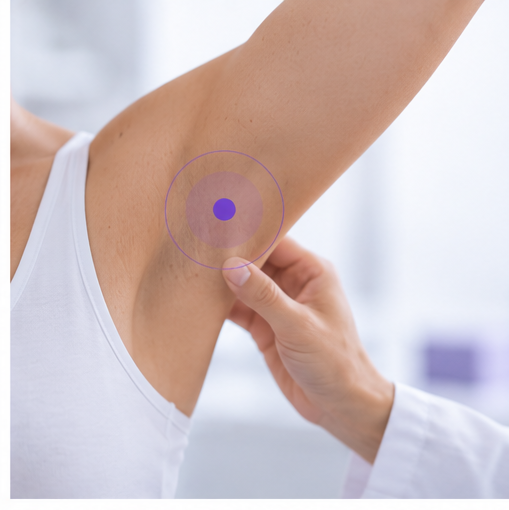
Lymphedema can be assessed in different ways. Circumference, limb volume, bioimpedance and TDC do not measure exactly the same thing - and different results between methods can provide useful information rather than indicate that one of them is wrong.
Lymphedema is often associated with swelling.
For this reason, many traditional assessment methods focus on a straightforward question:
Has the limb become larger?
This is an important question. But, another question has become increasingly relevant:
Is superficial tissue water content abnormally elevated somewhere within the tissue at risk?
These questions are related, but they are not identical.
Understanding the difference helps explain why circumference, limb volume, bioimpedance and Tissue Dielectric Constant (TDC) measurements may not always change in the same way.
Lymphedema is more than a change in limb size
When lymphatic transport becomes insufficient, fluid can accumulate within the tissues.
But this accumulation is not necessarily uniform throughout the limb.
In early and mild lymphedema, tissue-fluid accumulation can be localized and regionally distributed. Dermal backflow and other changes in superficial lymphatic transport may also occur in specific areas while nearby regions are less affected.
This means that a patient can have a meaningful local tissue abnormality without a large enough change to substantially alter total limb volume.
Recent clinical literature specifically recognizes this distinction. Johansson and Blom note that in mild arm lymphedema, lymph-fluid accumulation tends to be localized, which can limit the ability of whole-limb volume measurement—and potentially broader fluid measurements—to characterize local treatment effects. TDC, in contrast, measures localized tissue water content. Johansson o Blom, Prevention of…
What does circumference measure?
Tape measurement assesses the external geometry of the limb.
Measurements are typically taken at standardized positions and can be used to estimate changes in circumference or calculate limb volume.
This makes circumference measurement practical, inexpensive and clinically familiar.
But circumference does not directly measure tissue water content.
An increase in circumference can reflect several tissue components, including fluid, adipose tissue and other structural changes.
Likewise, a localized increase in superficial tissue water content may be too small or too regional to produce a measurable change in circumference.
So circumference primarily answers:
“Has the size of the limb changed?”
It does not directly answer:
“What is happening to superficial tissue water content at this specific location?”
What does limb volume measure?
Methods such as water displacement and perometry assess the overall volume of a limb or limb segment.
These methods can be valuable for determining whether the affected limb has become larger relative to baseline or the contralateral limb.
But again, the measurement integrates changes across a relatively large anatomical region.
Imagine a patient with increased superficial tissue water content in one part of the medial forearm while most of the arm remains relatively unchanged.
The abnormal region may be clinically meaningful, but its contribution to total arm volume may be small.
This is one reason localized and whole-limb measurements should not automatically be expected to identify exactly the same patients at exactly the same time.
In a study of mild breast cancer-related arm lymphedema, Karlsson and colleagues used local TDC measurements alongside water-displacement volume measurement and clinical palpation. The work demonstrated that local tissue-water assessment and limb-volume assessment can identify different aspects of early lymphedema.
What does bioimpedance measure?
Bioimpedance spectroscopy, or BIS, provides another perspective.
BIS uses the body's electrical impedance to estimate changes associated with extracellular fluid, typically across a relatively large tissue segment such as an arm.
It has an established role in lymphedema surveillance and can detect changes before substantial visible swelling develops.
However, BIS and TDC use different measurement principles and spatial perspectives.
A useful conceptual distinction is:
BIS provides information about fluid-related electrical properties across a larger limb or body segment.
TDC provides information about local superficial tissue water content at the specific location where the probe is placed.
Neither perspective makes the other unnecessary.
They answer different questions.
What does LymphScanner measure?
LymphScanner uses Tissue Dielectric Constant technology to assess local superficial tissue water content.
The measurement is made within a small tissue volume beneath the probe, with an effective measurement depth of approximately 2.5 mm.
Because the dielectric properties of tissue are strongly influenced by water, TDC provides an objective measure related to the water content within that localized superficial tissue volume.
The result is expressed as Percentage Water Content, or PWC.
Importantly, the measurement includes contributions from both free and bound tissue water. This is relevant because lymphedema tissue is not simply a container of freely moving fluid; tissue water exists within an evolving biological environment.
LymphScanner therefore asks:
“What is the local superficial tissue water content here?”
And when corresponding sites are compared:
“Is superficial tissue water content abnormally elevated here relative to an appropriate reference?”
Local versus global: the important difference
Consider a simplified example.
A patient develops an area of elevated superficial tissue water content in the medial forearm.
A TDC measurement made directly over that area may identify the local abnormality.
But that region represents only a small proportion of the entire arm.
The total increase in fluid may therefore be insufficient to create a substantial change in:
- total limb volume
- overall circumference
- whole-limb fluid estimates
This does not mean that the methods disagree.
It means they are looking at the patient from different spatial perspectives.
A whole-limb measurement integrates change across the limb. A local TDC measurement investigates what is happening at a specific tissue location.
Why can different measurements move in different directions?
This becomes particularly important when monitoring patients over time.
Lymphedema tissue is dynamic.
Fluid can change regionally. Tissue composition can change. Fibrosis can develop. Treatment may alter fluid distribution without producing an identical change at every anatomical site.
Consequently, it is possible for local superficial tissue water content to change while total limb volume changes very little.
It is also possible for limb volume to decrease while one local area continues to have elevated superficial tissue water content.
Neither observation should automatically invalidate the other.
Instead, the measurements should be interpreted according to what each method actually measures.
None of the methods are wrong - they are seeing something different
This is an important clinical principle.
Circumference, volume measurement, BIS, palpation and TDC should not necessarily be viewed as competing versions of the same measurement.
They provide different information.

This is why combining clinical assessment with objective measurements can provide a more complete understanding of the patient.
Johansson and Blom similarly recommend combining local tissue-water assessment with arm-volume measurement and palpation when assessing mild breast cancer-related arm lymphedema.
Why local measurement matters in early lymphedema
The distinction becomes especially important in early disease.
Early lymphatic dysfunction may be:
localized rather than widespread,
subclinical rather than visibly swollen,
and heterogeneous rather than uniform.
A whole-limb measurement asks whether enough change has accumulated across the limb to alter the overall measurement.
A localized TDC measurement asks whether superficial tissue water content is abnormal at the tissue location being examined.
This is why TDC can add information in prospective surveillance and early assessment.
It does not replace whole-limb measurements.
It adds the local tissue perspective.
Different methods can work together
There is no single measurement that describes every component of lymphedema.
A clinician may want to know:
Has the limb become larger?
- Circumference or volume measurement can help answer that.
Is there broader limb fluid asymmetry?
- BIS may provide useful information.
Does the tissue feel thicker, firmer or different?
- Clinical examination and palpation provide important information.
Where is local superficial tissue water content elevated?
- Localized TDC measurement can add that perspective.
This leads to a more useful question than asking which technology is “best”:
What clinical information do I need - and which measurement provides it?
Selected references
Karlsson K, Johansson K, Nilsson-Wikmar L, Brogårdh C. Local tissue-water and limb-volume assessment in mild breast cancer-related arm lymphedema.
Lahtinen T, Seppälä J, Viren T, Johansson K. Experimental and analytical comparisons of Tissue Dielectric Constant and bioimpedance spectroscopy in assessment of early arm lymphedema.
Liu Y, Long X, Guan J. Tissue Dielectric Constant Combined with Arm Volume Measurement as Complementary Methods in Detection and Assessment of Breast Cancer-Related Lymphedema. Lymphatic Research and Biology. 2022.
Johansson KI, Blom KY. Prevention of Breast Cancer-Related Arm Lymphedema. 2025.
Thomis S, et al. Clinical assessment and lymphofluoroscopy in breast cancer-related lymphedema.
Indication of Use
FDA clearance 510(k) in USA: LymphScanner is a device utilizing inter-aim ratios of tissue dielectric constant (TDC) that supports local assessment of tissue water differences between affected and contralateral non-affected arm tissues to aid in forming a clinical judgment of unilateral lymphedema in adult women. (K220557)
EU: LymphScanner is used to aid in forming a clinical judgement of edema at any soft tissue site of the body
Key takeaways
Limb volume and tissue water content are not the same measurement.Circumference and volume methods assess changes in limb dimensions, while LymphScanner measures local superficial tissue water content.
Lymphedema can be regional.
Localized tissue-water abnormalities may occur before enough change has accumulated to substantially affect whole-limb volume.
BIS and TDC provide different spatial perspectives.
BIS provides broader fluid-related information, while TDC investigates superficial tissue water content at a specific location.
Different results do not necessarily mean that one measurement is wrong.
Different methods can reflect different components, locations or stages of the disease.
LymphScanner adds the local tissue perspective.
Whole-limb measurements help show whether the limb has changed. LymphScanner helps show where local superficial tissue water content is abnormal.

